 Skip to content
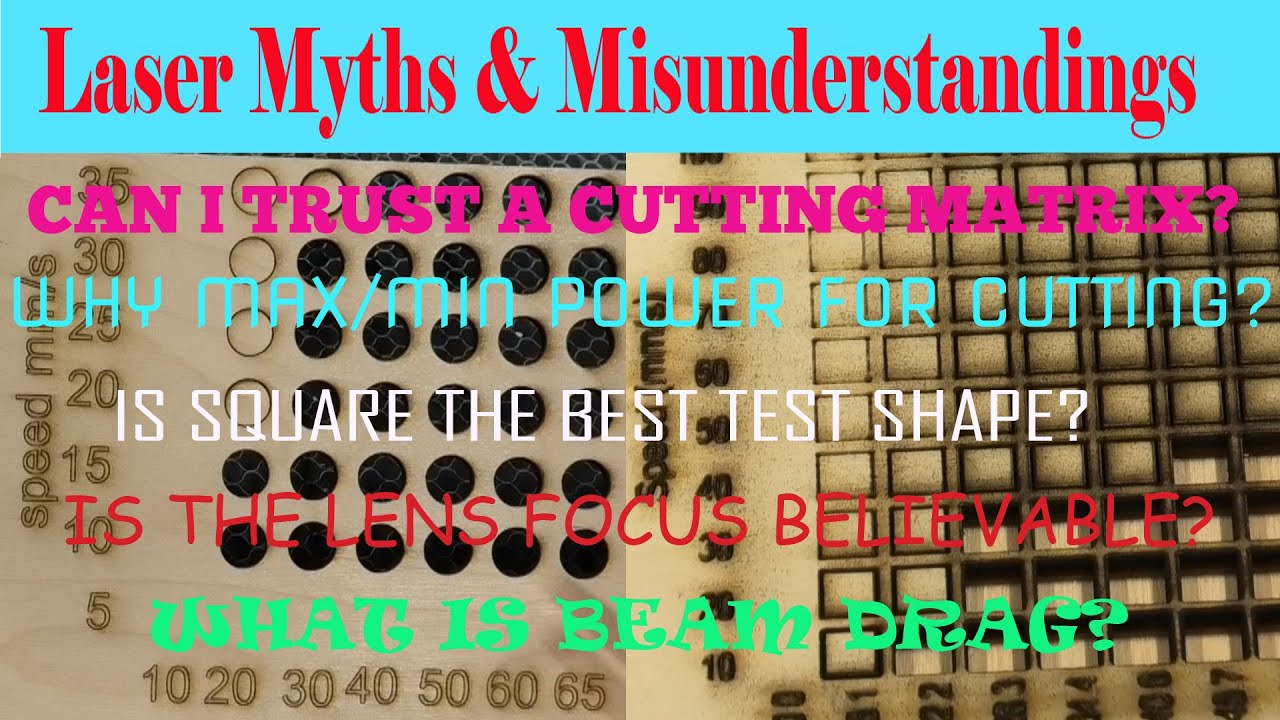
 Russ uses the familiar LightBurn cutting matrix to show why a grid of commanded speeds and powers can be misleading. His central point is that a test square does not prove the laser actually reached the speed shown on the label, particularly when the shape is too small for the machine to accelerate, run steadily and decelerate.
Previous: Laser Beams and Lenses – Part 2 | Series Menu | Next: Beam Setting and Alignment
What You’ll Learn
- Why the speed printed on a test square may not be the speed the laser actually achieved.
- Why small test shapes can distort the relationship between speed, exposure and cutting result.
- Why the material result matters more than the percentage shown in software.
A Matrix Is an Experiment
Russ demonstrates that the standard 5 mm test squares can spend much of their travel accelerating or decelerating. That changes the real exposure time and can make apparently equivalent settings disagree. Enlarging the test geometry gives the machine more opportunity to reach the commanded speed and makes the comparison more meaningful.
Look at the Cut, Not Just the Setting
Russ therefore treats the matrix as a diagnostic experiment rather than a settings oracle. Square size, controller behaviour, acceleration, actual tube output, edge quality and repeatability all affect what the result means.
Why This Session Matters
This session explains a specific failure mode in common cutting matrices: the labelled settings can imply precision that the motion system did not actually achieve. The useful lesson is to design the test around the dynamics of the machine, then judge the material result rather than trusting the labels alone.
This page is a concise overview of Russ Sadler’s original video rather than a full transcript.
