 Skip to content
 Short answer: the best way to extend the life of a glass CO₂ laser tube is to operate it within the manufacturer’s recommended current, keep the cooling system effective, maintain a clean and well-aligned optical path, and avoid using extra power to compensate for dirty optics or poor setup. Tube quality and supplier traceability also matter.
This page is the practical maintenance guide. If you are trying to understand expected lifespan, warranty versus useful life, or how to tell whether the tube itself is ageing, start with How Long Does a CO₂ Laser Tube Last?
- Know the exact tube model and its rated output.
- Use the manufacturer’s recommended operating current, not a generic software percentage.
- Keep coolant flow and temperature within the tube manufacturer’s limits.
- Keep mirrors and the focusing lens clean and correctly aligned.
- Measure optical output periodically so gradual degradation is visible before it becomes a production problem.
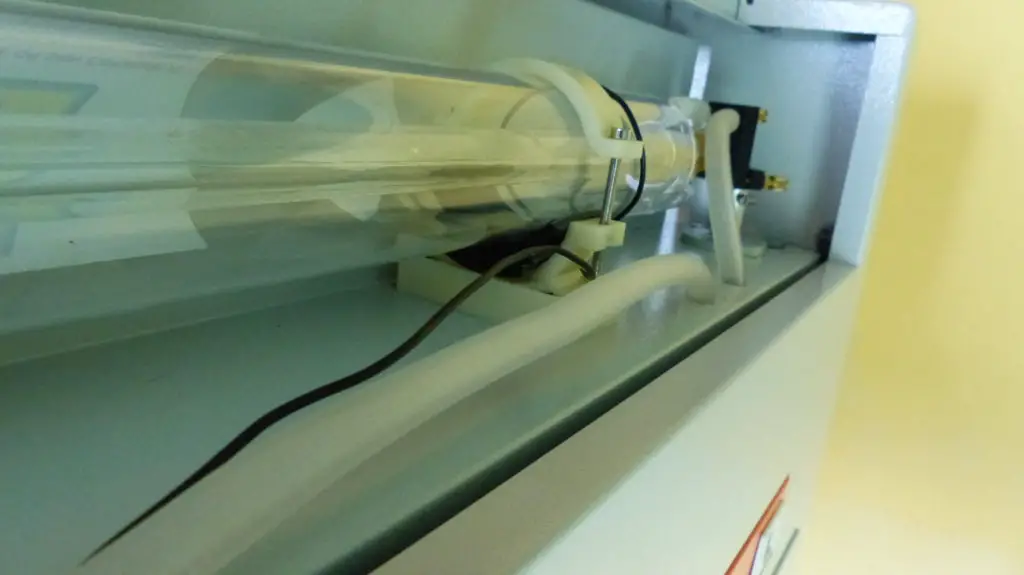
Running costs on a laser cutting and engraving machines are relatively low. However, the biggest consumable cost you will be faced with is replacing the laser tube. Get it wrong and you could be looking at replacing tubes every 3 months. With a little bit of planning, preparation and preventative maintenance you can generally prolong the lifespan of your tube significantly. These tips will help guide you to getting a decent tube and then to keep it in peak condition for as long as possible.
9 Tips On How To Get A Longer Life From Your Laser Tube
1. Identify the exact tube fitted to the machine
Record the manufacturer, model, rated optical power, recommended operating current, maximum current, physical size and date of manufacture. Do not rely on machine-advertising wattage alone. Some manufacturers publish both a rated output and a higher maximum output, and the rated value is the more useful reference for continuous operation and replacement matching.
2. Use a traceable tube from a recognised manufacturer
A branded tube with an accessible data sheet makes maintenance much easier because you can check the correct current, cooling requirements and warranty terms. RECI and SPT are examples of manufacturers that publish current technical information for their CO₂ tube ranges. The aim is not to choose a brand from a league table; it is to know exactly what has been fitted and what operating limits apply.
3. Buy replacements from a supplier that can confirm specification and provenance
Ask the supplier to confirm the exact model and rated power before purchase. A useful replacement should match the machine mechanically and electrically and should have clear manufacturer identification. Keep photographs of the label and the supplier documentation so you have a baseline if a warranty or performance issue arises later.
4. Correct Laser Power:
Check that the specified power actually reflects the tube you are expecting to arrive, it is easy to check the manufacturer’s websites for information on a particular tube.
5. Measure tube current
A milliammeter lets you see how hard a glass CO₂ tube is being driven. Compare the measured current with the recommended operating current for the exact tube model, not with a generic percentage copied from another machine.
If your controller allows a machine-level maximum output limit, establish that limit from measured current and the manufacturer’s specification. See the Laser Cutter Power Guide for the difference between controller percentage, tube current and measured optical watts.
6. Buy a Laser Power Meter:
I would suggest you use a laser power meter and regularly check the output of your laser tube. It’s also a great tool for troubleshooting problems. For the majority of users, it is not worth purchasing a professional laser power meter at several hundred $ £ € as you are looking for an indicative value rather than a precise value. As laser tubes gradually degrade over time, a laser power meter will help you to decide when the time is right to start getting a replacement.
7. Record the manufacture date and warranty terms
Keep a photograph of the tube label when the machine or replacement tube arrives. Warranty start dates and failure criteria vary between manufacturers and suppliers, so check the current terms for the exact product rather than assuming every tube is covered from the same date or to the same power threshold.
8. Keep the optical path clean and aligned
Contaminated or misaligned mirrors and lenses reduce the useful power reaching the workpiece. That can tempt the operator to increase power or slow the job even though the tube itself is healthy. Inspect optics at intervals appropriate to the machine, material and workload, and clean them using the optic manufacturer’s recommended method rather than a fixed daily or weekly schedule.
9. Control coolant temperature and flow
Use a cooling system capable of maintaining the tube within the manufacturer’s specified coolant-temperature and flow range. Flow protection is particularly valuable because a loss of circulation can overheat the tube rapidly.
Avoid cooling below the local dew point, because condensation can form on the tube and high-voltage components. The correct temperature target therefore depends on both the tube specification and the workshop environment rather than a single universal number.
Why does a glass CO₂ laser tube degrade?
Sealed glass CO₂ tubes are consumable laser sources. Their output can decline as the internal discharge, gas mixture and electrodes change with use and operating conditions. Overdriving the tube or allowing it to run too hot can accelerate that decline.
The practical sign of ageing is not simply that a job needs a higher software percentage. Measure tube current and optical output. If the current is within specification but the measured watts have fallen compared with earlier readings, the tube may be ageing. If output at the tube remains healthy, investigate the optical path, focus and process setup first.
What is the warranty on a glass CO₂ laser tube?
Warranty terms vary by manufacturer, model, rated power and supplier. There is no universal rule for the start date or the percentage of rated power that defines a warranty failure. Check the current terms supplied with the exact tube and keep the label, invoice and baseline power measurements.
RECI currently states a 12–18 month warranty for its CO₂ laser tubes, while other manufacturers publish different terms. This is why the current manufacturer documentation should take precedence over figures copied from an older article, reseller listing or another tube model.
What about proprietary or custom laser tubes?
Some desktop laser systems use custom tube assemblies for which the OEM does not publish the same technical detail as a standalone tube manufacturer. In those cases, do not estimate life from tube length, assumed manufacturer or forum reports. Use the machine manufacturer’s service information and judge source condition from repeatable performance and power measurements where safe and practical.
What Next?
Did you enjoy this post? Why not check out some of our other posts:
Disclaimer
Last updated April 25, 2024
WEBSITE DISCLAIMER
The information provided by n-Deavor Limited, trading as Laseruser.com (“we,” “us” , or “our”) on (the “Site”) is for general informational purposes only. All information on the Site is provided in good faith, however we make no representation or warranty of any kind, express or implied, regarding the accuracy, adequacy, validity, reliability, availability or completeness of any information on the Site.
UNDER NO CIRCUMSTANCE SHALL WE HAVE ANY LIABILITY TO YOU FOR ANY LOSS OR DAMAGE OF ANY KIND INCURRED AS A RESULT OF THE USE OF THE SITE OR RELIANCE ON ANY INFORMATION PROVIDED ON THE SITE. YOUR USE OF THE SITE AND YOUR RELIANCE ON ANY INFORMATION ON THE SITE IS SOLELY AT YOUR OWN RISK.
EXTERNAL LINKS DISCLAIMER
The Site may contain (or you may be sent through the Site) links to other websites or content belonging to or originating from third parties or links to websites and features in banners or other advertising. Such external links are not investigated, monitored, or checked for accuracy, adequacy, validity, reliability, availability or completeness by us.
WE DO NOT WARRANT, ENDORSE, GUARANTEE, OR ASSUME RESPONSIBILITY FOR THE ACCURACY OR RELIABILITY OF ANY INFORMATION OFFERED BY THIRD-PARTY WEBSITES LINKED THROUGH THE SITE OR ANY WEBSITE OR FEATURE LINKED IN ANY BANNER OR OTHER ADVERTISING.
WE WILL NOT BE A PARTY TO OR IN ANY WAY BE RESPONSIBLE FOR MONITORING ANY TRANSACTION BETWEEN YOU AND THIRD-PARTY PROVIDERS OF PRODUCTS OR SERVICES.
AFFILIATES DISCLAIMER
The Site may contain links to affiliate websites, and we receive an affiliate commission for any purchases made by you on the affiliate website using such links. Our affiliates include the following:
- makeCNC who provide Downloadable Patterns, Software, Hardware and other content for Laser Cutters, CNC Routers, Plasma, WaterJets, CNC Milling Machines, and other Robotic Tools. They also provide Pattern Files in PDF format for Scroll Saw Users. They are known for their Friendly and Efficient Customer Service and have a comprehensive back catalogue as well as continually providing New Patterns and Content.
- Cloudray Laser: a world-leading laser parts and solutions provider, has established a whole series of laser product lines, range from CO2 engraving & cutting machine parts, fiber cutting machine parts and laser marking machine parts.
