 Skip to content
 K40 Xtreeem: Rebuilding a K40 as an Engineering Platform
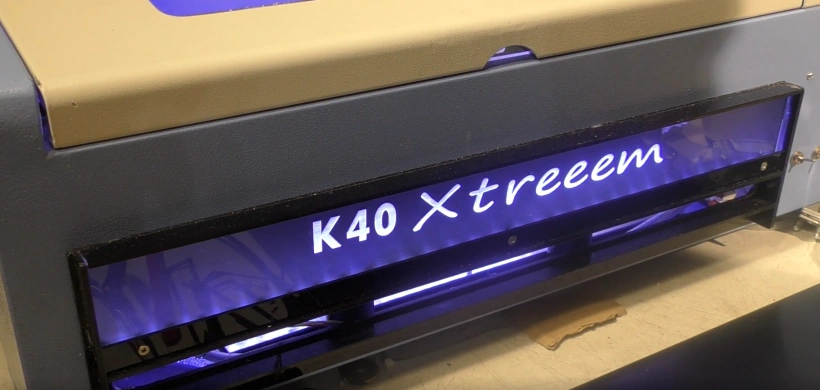
The K40 Xtreeem series follows Russ Sadler as he takes a basic K40-style CO₂ laser cutter and rebuilds it around a more capable mechanical, optical and control architecture. The objective is not a cosmetic modification. It is to test how far a compact low-cost chassis can be pushed when the motion system, controller, optics, utilities and setup are treated as one integrated machine. For the complete collection of LaserUser training series, return to Laser Video Tutorials.
The project develops over eight main sessions, followed by project-file and mechanical-kit addendums. Unlike the Tangerine Tiger series, this is primarily a build-and-commissioning project: the strongest value is in the engineering choices, installation sequence, setup methods and practical constraints rather than in proving one single laser-physics hypothesis.
What the Series Changes
- Motion system: the original lightweight XY arrangement is replaced and reinforced using linear bearings, revised brackets and a more rigid head arrangement.
- Optical setup: Russ redesigns the head, tube mounting and mirror arrangement to make beam alignment and focal-height adjustment more controllable.
- Controller: the original K40 electronics are replaced by a Ruida-based digital control system with separate stepper drivers and revised electrical layout.
- Utilities: cooling, extraction and air assist are reorganised into a more practical system rather than being treated as afterthoughts.
- Commissioning: the later sessions focus on alignment, acceleration, engraving, cutting and whether the upgraded mechanics translate into useful real-world performance.
- Rotary capability: Sessions 7 and 8 explore a compact rotary design that works within the limited physical envelope of the K40 chassis.
More Than a K40 Upgrade
Although the project starts with a K40 chassis, the engineering principles extend well beyond K40 machines. The series is also a practical reference for people building a compact CO₂ gantry laser around an existing chassis or enclosure, and for owners of larger Chinese or custom-built CO₂ systems who want to improve mechanics, optics, beam delivery, motion control, focal control or serviceability.
Russ is effectively working through the same subsystem problems that appear in a new machine design: gantry stiffness, bearing and rail selection, belt attachment, moving mass, tube positioning, mirror access, optical-path geometry, head design, focus adjustment, air assist, cooling, extraction, controller integration and commissioning. The physical dimensions are K40-specific, but the engineering method is scalable: identify the limiting subsystem, change one part of the system, then realign, retune and validate the complete machine.
This makes the series useful for niche and special-purpose CO₂ laser development as well as hobby-machine upgrades. A custom machine may be much larger, use different motion hardware or process very different materials, but it still has to solve the same underlying questions of controlled motion, stable beam geometry, repeatable focus, process-gas delivery and maintainable integration.
What This Project Is — and Is Not
The K40 Xtreeem should not be read as a claim that every K40 should be rebuilt this way, or that the economics always make sense. Russ says early in Session 1 that much of the appeal is the engineering challenge itself. The project is therefore most useful to owners who want to understand how a compact CO₂ gantry machine works as a system and who are comfortable with mechanical and electrical modification.
Some dimensions, brackets and component choices are specific to the machine used in the series. The transferable value lies in the design principles: rigidity, controlled alignment, sensible beam-path geometry, safe high-voltage practice, proper motion control, effective cooling and extraction, and validating performance after the rebuild.
K40 Xtreeem Upgrade Series — Session Index
Session 1 — Upgrading the Mechanics (37:02)
Russ removes the original XY mechanics, adds linear-bearing support, redesigns the laser head mounting, increases useful travel and develops a tube-and-first-mirror arrangement intended to make alignment more repeatable. The session also identifies an exposed high-voltage connection that needs safer treatment.
Session 2 — Changing the Controller (48:21)
The original K40 control system is replaced with a Ruida-based digital controller, separate stepper drivers and a revised control panel and power layout. This establishes the control architecture used for the rest of the project.
Session 3 — Integrating the Utility Upgrades (51:49)
Cooling, water storage, extraction, air assist and electrical services are brought together into a more coherent support system. The emphasis is on making the machine easier to operate and maintain rather than simply adding accessories one at a time.
Session 4 — Finishing the Build and Machine Setup (56:56)
The upgraded machine is assembled and commissioned. Russ works through beam alignment, tube positioning, optical setup and the practical details needed before performance testing can begin.
Session 5 — Optimising the Performance (30:01)
With the build complete, Russ tunes motion settings and acceleration and begins separating maximum commanded speed from useful machine performance. This is where the mechanical rebuild starts to be judged by what the machine can actually do.
Session 6 — Putting the K40 Xtreeem to the Test (52:20)
Russ evaluates engraving and cutting performance on real materials, including demanding engraving examples. The important question is no longer whether the modifications fit, but whether the complete system produces useful, repeatable results.
Session 7 — Building a K40 Xtreeem Rotary Attachment, Part 1 (43:15)
Russ develops a rotary concept specifically around the K40’s limited internal height. The design goal is to add cylindrical-work capability without relying on a large open-bottom conversion.
Session 8 — Building a K40 Xtreeem Rotary Attachment, Part 2 (39:59)
The rotary system is refined and integrated with changes to the head, lens-tube arrangement and Y-axis handling. The result is tested as part of the completed compact machine rather than as a separate accessory in isolation.
What Is Most Transferable to Other K40-Style Machines?
- Reducing play and uncontrolled flex in the motion system before chasing higher speed.
- Making the tube, first mirror and moving optics adjustable in a controlled and repeatable way.
- Using a controller and stepper-drive architecture that gives proper control over speed, acceleration and machine parameters.
- Treating cooling, extraction and air assist as part of machine performance and reliability.
- Commissioning the machine methodically before judging cutting or engraving quality.
- Designing around the actual physical constraints of the chassis instead of assuming a larger machine’s solution can simply be scaled down.
Project Files and Mechanical-Kit Addendums
K40 Xtreeem Project Files
Drawings and reference files used to manufacture components shown in the series. These should be treated as project-development files rather than guaranteed universal-fit production drawings, because individual K40 machines can vary.
Preparing the K40 Xtreeem Mechanical Kit (51:31)
A detailed walkthrough of the brackets, rails, fixings and sub-assemblies used in the mechanical conversion.
Summary of Fixings for the K40 Xtreeem Mechanical Kit (08:43)
A shorter reference covering the principal mechanical hardware and fixings used by Russ.
Safety and Scope
This series includes mains wiring, high-voltage CO₂ laser circuitry, exposed optical alignment work, mechanical modification and changes to factory safety-related systems. The historical videos document Russ’s own build; they are not a substitute for electrical competence, suitable interlocks, guarding, extraction, fire precautions or compliance with local electrical and laser-safety requirements.
In particular, modifications around the laser tube and high-voltage connection should be approached conservatively. CO₂ laser power supplies can retain hazardous energy, and an apparently small K40 still contains potentially lethal high voltage.
Who This Series Is For
The K40 Xtreeem series is best suited to technically confident K40 owners, makers, educators and engineers who want to understand the machine rather than simply install a collection of bolt-on upgrades. It is especially useful if the objective is to improve mechanical control, alignment, serviceability and system integration.
If the objective is simply to obtain a larger working area, more laser power or a production-ready machine with minimal workshop time, the economics of a deep K40 rebuild should be compared carefully with buying a larger machine designed around those requirements from the outset.
Contact Russ About the Project
For questions about the K40 Xtreeem project, drawings or parts, use the enquiry form below.
K40 Xtreeem FAQ
Do I need to complete every upgrade?
No. The project is modular, but later stages assume that the machine is mechanically sound and properly aligned. A controller upgrade will not compensate for a loose gantry, and better mechanics will not compensate for poor beam alignment or inadequate cooling.
Does the project increase the laser tube’s wattage?
No. The rebuild is about using the available optical power more consistently through better mechanics, alignment, control and supporting systems. It does not create additional laser-tube output.
Can the same parts be assumed to fit every K40?
No. K40 is a generic machine category rather than one tightly controlled design. Chassis dimensions, electronics, tube mounts and mechanical details vary between suppliers and production runs, so dimensions should be checked against the actual machine before fabrication.
Is the Ruida controller essential?
It is central to Russ’s build because it provides the motion-control and machine-setting framework used throughout the later sessions. Other control architectures are possible, but they would create a different project and require their own wiring, configuration and software workflow.
Is the rotary attachment required?
No. Sessions 7 and 8 are an optional extension for cylindrical work. The core K40 Xtreeem rebuild is complete before the rotary project begins.
What Next?
Did you enjoy this post? Why not check out some of our other posts:
Disclaimer
Last updated April 25, 2024
WEBSITE DISCLAIMER
The information provided by n-Deavor Limited, trading as Laseruser.com (“we,” “us” , or “our”) on (the “Site”) is for general informational purposes only. All information on the Site is provided in good faith, however we make no representation or warranty of any kind, express or implied, regarding the accuracy, adequacy, validity, reliability, availability or completeness of any information on the Site.
UNDER NO CIRCUMSTANCE SHALL WE HAVE ANY LIABILITY TO YOU FOR ANY LOSS OR DAMAGE OF ANY KIND INCURRED AS A RESULT OF THE USE OF THE SITE OR RELIANCE ON ANY INFORMATION PROVIDED ON THE SITE. YOUR USE OF THE SITE AND YOUR RELIANCE ON ANY INFORMATION ON THE SITE IS SOLELY AT YOUR OWN RISK.
EXTERNAL LINKS DISCLAIMER
The Site may contain (or you may be sent through the Site) links to other websites or content belonging to or originating from third parties or links to websites and features in banners or other advertising. Such external links are not investigated, monitored, or checked for accuracy, adequacy, validity, reliability, availability or completeness by us.
WE DO NOT WARRANT, ENDORSE, GUARANTEE, OR ASSUME RESPONSIBILITY FOR THE ACCURACY OR RELIABILITY OF ANY INFORMATION OFFERED BY THIRD-PARTY WEBSITES LINKED THROUGH THE SITE OR ANY WEBSITE OR FEATURE LINKED IN ANY BANNER OR OTHER ADVERTISING.
WE WILL NOT BE A PARTY TO OR IN ANY WAY BE RESPONSIBLE FOR MONITORING ANY TRANSACTION BETWEEN YOU AND THIRD-PARTY PROVIDERS OF PRODUCTS OR SERVICES.
AFFILIATES DISCLAIMER
The Site may contain links to affiliate websites, and we receive an affiliate commission for any purchases made by you on the affiliate website using such links. Our affiliates include the following:
- makeCNC who provide Downloadable Patterns, Software, Hardware and other content for Laser Cutters, CNC Routers, Plasma, WaterJets, CNC Milling Machines, and other Robotic Tools. They also provide Pattern Files in PDF format for Scroll Saw Users. They are known for their Friendly and Efficient Customer Service and have a comprehensive back catalogue as well as continually providing New Patterns and Content.
- Cloudray Laser: a world-leading laser parts and solutions provider, has established a whole series of laser product lines, range from CO2 engraving & cutting machine parts, fiber cutting machine parts and laser marking machine parts.
