 Skip to content
 Fiber Laser Learning Lab with Russ Sadler
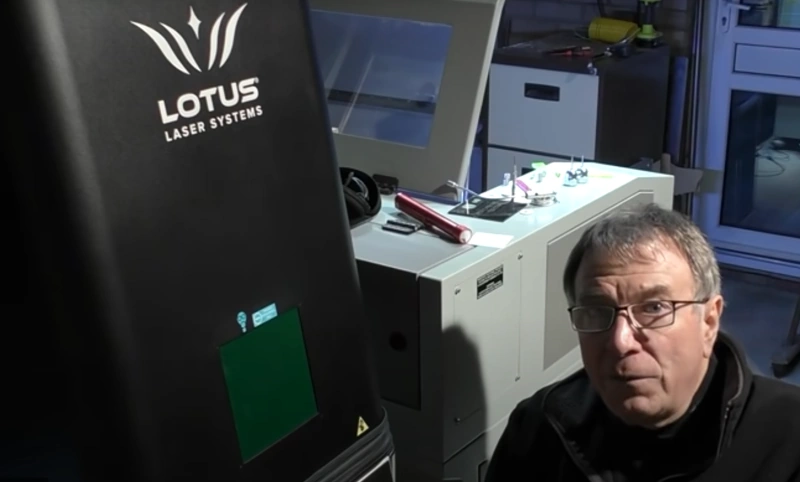
The Fiber Laser Learning Lab follows Russ Sadler as he learns how to use a 20 W MOPA fibre laser marking system supplied on loan by Lotus Laser. Rather than treating fibre marking as a collection of fixed recipes, Russ works experimentally: change one parameter, observe the result, form a hypothesis, then test it again on a different material or marking condition.
The result is a 21-part practical investigation into pulse width, repetition frequency, scan speed, hatch spacing, focus, energy density, colour formation, material response and back reflection. The series is particularly useful for people trying to understand why fibre-laser settings behave the way they do instead of simply copying parameter tables.
What Makes This Series Useful
Fibre laser marking is highly parameter-dependent. Two jobs that look similar can require very different combinations of pulse width, frequency, speed, power and hatch spacing. The series therefore works best as an engineering learning resource, not as a universal settings library.
- MOPA pulse control: how pulse width and repetition frequency alter energy delivery and material response.
- Colour marking: practical exploration of coloured oxide and interference effects on suitable metals.
- Focus and spot behaviour: how working distance and focus affect mark size, intensity and processing behaviour.
- Material interaction: experiments on anodised aluminium, steel, wood, slate, acrylic and other materials.
- Parameter interaction: why power, speed, frequency, pulse width and hatch spacing cannot always be treated independently.
- Machine limits and risk: later sessions examine back reflection and why some apparently successful settings may still be poor engineering practice.
How to Use the Series
Russ explicitly approaches the subject as an investigator rather than as a fibre-laser manufacturer or academic specialist. That is valuable, but it also means some early explanations are provisional and some scientific descriptions are deliberately simplified. The rebuilt episode pages should therefore be read with an evidence hierarchy in mind: what was measured, what was observed, what was inferred, and what was only a working hypothesis at that point in the series.
This is also why later episodes matter. Several ideas become clearer only after repeated experiments. The historical progression is part of the value: a parameter that appears to control one effect early in the series may later turn out to interact strongly with another setting or with the material itself.
The 21-Part Fiber Laser Learning Lab
Phase 1 — Learning the machine and pulse controls
01. Introduction to Russ, Lasers and Fiber Laser Marking (58:33) — the machine, the software and the starting questions.
02. MOPA Matrix Test Leads to Understanding (20:59) — using controlled parameter matrices to reveal trends.
03. Light, Aluminium and Water (23:18) — early attempts to reason about absorption and material interaction.
04. Fiber Laser Colour Marking (25:47) — the first focused colour-marking experiments.
05. Let’s Test Some Fiber Laser Pulses (39:13) — pulse behaviour and how MOPA settings change the mark.
Phase 2 — Colour, focus and material response
06. The Search for Colour — Part 1 (32:08).
07. The Hunt for Colours — Part 2 (28:25).
08. Let’s Try the Impossible (03:54) — testing an apparently unsuitable material rather than accepting a rule at face value.
09. Let’s Zoom in on Focus (34:38) — focus, working distance and the effect on mark behaviour.
10. Black Marking Clear Anodising (25:17).
11. We Are No Longer Flying Blind (23:17) — using better measurement and observation to constrain the settings problem.

Phase 3 — Building a colour model
12. The Search for Colour — Part 3 (41:12).
13. Mining for Gold (33:36) — searching for repeatable colour conditions rather than isolated attractive marks.
14. Is This Fool’s Gold? (23:53) — checking whether the apparent result survives closer examination.
15. A Palette of Sparkly Colours (39:04).
16. Colours Part 4 — The Rainbow’s End (50:12).

Phase 4 — Wavelength, interacting parameters and machine risk
17. The Mysteries of 1 Micron Wavelength Light (45:58) — a broader attempt to connect wavelength with material response.
18. Intertwined Parameters (53:00) — one of the central lessons of the series: settings interact rather than acting as independent controls.
19. Back Reflection (01:03:31) — why process success and machine safety are not always the same thing.
Phase 5 — Applying the learning to unusual materials
20. 20 W MOPA Fibre Laser: Photo Engraving on Slate (58:26).
21. Bubble Marking Clear Acrylic (46:12) — exploring subsurface effects in a material normally associated with CO₂ rather than 1 µm processing.
A Resource for More Than One Machine
The machine in this series is a specific 20 W MOPA system, but the experimental method is much more transferable. Anyone tuning a MOPA or Q-switched fibre marker faces the same broad questions: how much energy reaches each point, how quickly the material is revisited, whether the process is heating, oxidising, ablating or modifying the surface, and whether a visually successful result is stable and repeatable.
That makes these pages useful for parameter development, process optimisation, material testing, colour marking, focus studies and troubleshooting on a wide range of fibre laser systems. Exact settings should not be copied blindly between machines because source type, pulse characteristics, lens, field size, calibration and material condition all matter.
Safety and Technical Scope
Fibre marking systems operate at approximately 1 µm wavelength, which is invisible and can present serious eye and skin hazards. Metal surfaces can also produce hazardous reflections, including back reflection into the optical system. The historical videos document experiments; they should not be treated as a substitute for appropriate guarding, enclosure, extraction, eyewear where required, risk assessment or manufacturer guidance.
Where the spoken explanation simplifies laser physics or material science, the rebuilt episode commentary will preserve Russ’s original experiment while separating observation from interpretation. This is especially important for colour formation, absorption, thermal effects, pulse behaviour and unusual-material processing.
More LaserUser Learning Series
For CO₂ machine engineering, see the K40 Xtreeem engineering series, the Tangerine Tiger RF vs DC CO₂ experiments, the Lightblade Learning Lab, or the Concise RDWorks Learning Lab.
